Showing posts with label meaning. Show all posts

Saturday, 17 October 2020

On the Failures of Nonsense-Policing and Ordinary Language Philosophy

In this post I reflect on the failures of nonsense-policing and ordinary language philosophy, and the fact that notwithstanding these failures, paying critical attention to semantic issues is of central importance in philosophy, and in metaphysics as well as philosophy of language. 

The early Twentieth Century saw a surge of interest in the idea that the apparently intractable problems of philosophy come from misunderstanding language, and that philosophical questions are often unanswerable not because they are too difficult for us, but because they fail to make sense, or we fail to understand them properly.


This idea took various forms. The logical positivists attempted to give general criteria of meaningfulness using the notion of verification, the early Wittgenstein aims at a comprehensive, general theory of how language represent which leaves no place for genuine philosophical propositions, and more specific doctrines in logic and philosophy of language were used to dissolve particular problems.


Logical positivists attempted to formulate a criterion of meaningfulness in terms of the notion of verifiability. The basic idea is that a meaningful sentence must either be analytic (i.e. true in virtue of meaning) or verifiable in principle by experience. Philosophical sentences which are neither analytic nor verifiable experientially are therefore meaningless if this idea is correct, and works of metaphysics appear to be full of such sentences. As powerful as this idea seemed to the logical positivists, attempts to work it out in detail ran into trouble. There are also serious problems affecting even the basic idea; what about statements about minute happenings in the distant past, or events outside our light cone? (Such cases are more or less worrying depending on how one thinks about ‘verifiability in principle’.) And what about competing theoretical claims that do not appear to be analytic but where the contest does not appear to be settled by any possible experience? These arise in science as well as philosophy and we seem to decide about them on the basis of things like theoretical virtues rather than empirical tests. Thus the whole idea of experiential verifiability as a criterion of meaningfulness has been largely abandoned (at least in academic philosophy; it enjoys a vigorous half-life, along with Popper’s idea that truly scientific theories must be falsifiable, in the wider intellectual culture).


Wittgenstein in the Tractatus (a source of inspiration for the verificationists) attempts to say in general how meaningful propositions are constructed. In numbered, often cryptic remarks, we are given a beautiful, austere picture of how language represents. Elementary propositions are constructed out of names, and more complex propositions are constructed from them by simple logical operations. Anything which can’t be constructed in this way is not a genuine proposition. And many sentences in philosophical works fail to be genuine propositions. Wittgenstein’s proposal is that, with theses and questions in metaphysical philosophy, something akin to what is wrong with the sentence ‘Mortality is Socrates’ has gone wrong, only more subtly so.


(Wittgenstein’s later work is also replete with denials of sense, although it is up for debate what these come to and what they are based on. Assessing expressions for sense becomes a looser, more occasion-sensitive affair in the later work, as opposed to being based on some general theory of meaningfulness. Sense-denying aspects of Wittgenstein’s work, and interpreters of his work who emphasise them (e.g. P.M.S. Hacker), have come in for extensive criticism, and are seldom echoed in more recent contemporary philosophy. I see them as an unfortunate holdover from the early work, and as marking a place where Wittgenstein’s ideas require both revision and further development.)


Apart from general criteria of meaningfulness and overarching theories of what can be said, logical doctrines about particular parts of language have also been used to dispense with philosophical problems by denying sense. A famous example is the doctrine, defended by Bertrand Russell and wielded by many later writers (a prominent example being Rudolph Carnap), that ‘exists’ cannot be used with proper names. This is a kind of modern logical version of Kant’s doctrine that existence is not a predicate. From a contemporary point of view, this seems hopelessly revisionary. What we ordinarily call ‘proper names’ can meaningfully be put together with ‘exists’, and logically minded philosophers must accommodate this fact as best they can. 


The above views have in common that they are supposed to be based on the technical foundation of modern logic. Another influential Twentieth Century development of the idea that a better understanding of linguistic meaning is methodologically crucial is the Ordinary Language Philosophy (OLP) movement, as spearheaded by J.L. Austin. In a way it involves a kind of nonsense policing, but there is no general, technical policy that is being enforced; the OLP nonsense police, if that’s what they are, know that they’re operating in a complicated society and will require good judgement. This no doubt enhanced OLP’s plausibility in the wake of logical positivism’s failure.


I once heard from a mentor that in the 1960’s there was a feeling in the air that the traditional problems of philosophy would soon be cleared up by means of OLP. That this hasn’t happened should be uncontroversial. Why it hasn’t happened is more controversial, but we can speculate. One factor seems to be that the urge to use language in extraordinary ways is deep-rooted. No amount of attention to ordinary usage can stop it. Metaphysicians have become more self-conscious about the fact that their use of key terminology may depart from ordinary usage, and have found ways to persist in it nonetheless. (For example, in response to arguments by Eli Hirsch to the effect that non-commonsensical claims in ontology simply couldn’t be true, since they fly in the face of metasemantic wisdom - charity demands that we interpret natural language sentences so they aren’t radically false - Theodore Sider has argued that non-commonsensical metaphysical views should be regarded as being stated in Ontologese, a special non-ordinary language. For the Hirsch-Sider debate, see (in dialectical order) Hirsch (2010) (a collection of essays), Sider (2009), Hirsch (2008) and Sider (2014).)


Another factor may be a lack of technical sophistication: philosophy can get quite technical, but OLP tends not to come along for the ride. (Perhaps proponents of OLP could have done better here, either by coming along for the ride in some fashion or by forestalling misguided research programmes.) OLP at its most interesting can also become quite idiosyncratic and fragile, in contrast to a more recent trend of international and interpersonal cooperation. One of the most intriguing developments of OLP, the work of Stanley Cavell, typifies this tendency: you see all this sophistication, all these interesting scruples, but you have to be a special kind of person in a special kind of culture to appreciate it. Interesting as it may be, such work can be difficult to make use of in the sort of thing that Bertrand Russell called ‘technical philosophy’. Above all, the ordinary language philosophy of the mid Twentieth Century has simply been sidelined by more vital developments in connection with which it appears at least to have little to offer. Quine, Putnam, Kripke, Lewis and many others come on the scene, we get a whole raft of topics and problems to work on, and ordinary language philosophy falls by the wayside. 


The failures of nonsense-policing and ordinary language philosophy have had the unfortunate consequence of leading to complacency about sense in contemporary philosophy; a kind of presumption of innocence, where once basic standards of clarity have been met, we tend to take it for granted that philosophers’ utterances are meaningful and that we understand well enough what they mean. According to this way of thinking, the important work in philosophy tends to consist, not in inquiring not into the sense of expressions, but rather into which claims are true.


But the failure of nonsense-policing should not be taken to suggest that the analysis of meaning is not of central importance in philosophy. There may not be much of a future for denying meaning to animating words and phrases, but there remains a need to be critical and inquisitive about what they do mean. We are often being critical in this way even if we aren’t explicitly talking about meaning, or aren’t doing so systematically. But to get further we need to be able to be self-conscious and systematic, without losing crucial data that doesn’t fit well with the kind of thin, reference-based conception of meaning that now seems to hold sway again in philosophy.


References


Hirsch, Eli (2010). Quantifier Variance and Realism: Essays in Metaontology. Oxford University Press.

Hirsch, Eli (2008). Language, ontology, and structure. Noûs 42 (3):509-528.

Sider, Theodore (2009). Ontological realism. In David John Chalmers, David Manley & Ryan Wasserman (eds.), Metametaphysics: New Essays on the Foundations of Ontology. Oxford University Press. pp. 384-423.

Sider, Theodore (2014). Hirsch's Attack on Ontologese. Noûs 48 (3):565-572.

Sunday, 8 December 2019

Against Inherently Representational Anything

Soames, in his fascinating recent work Rethinking Language, Mind, and Meaning, begins by posing a problem for the study of meaning and language as developed by philosophers and logicians in the Twentieth Century.

For propositions to play the theoretical roles assigned to them - such as being the primary bearers of truth, being the objects of propositional attitudes like belief and desire, being the contents of mental and perceptual states, and being the meanings of some sentences - they, Soames says, must be inherently representational. That is, they must impose conditions on the world off their own bat, so to speak. 

But, argues Soames, the sorts of things that traditionally play the proposition role in modern theories do not seem to be inherently representational. Soames provides 'reasons to believe that no set-theoretic construction of objects, properties, world-states or other denizens of Plato’s heaven, could ever be inherently representational bearers of truth conditions in this sense' (Rethinking, Ch. 2).

This leads Soames to his new theory of propositions, on which they are cognitive acts of a certain kind. ('Suppose, however, we start at the other end, taking it as an uncontested certainty that agents represent things as being certain ways when they think of them as being those ways' (Rethinking, Ch. 2).) For example, the proposition that snow is white, on Soames's theory, is the act of predicating whiteness of snow. These cognitive acts, according to Soames, are inherently representational, which means that they could be able to play the role of propositions. 

(Soames says that, at bottom, it is language users that represent things as being certain ways, and they do this by performing cognitive acts, which acts may derivatively be said to represent. But although, in this way, they represent in a derivative sense, they do so inherently - and that is the crucial point for Soames, that makes cognitive acts fit to play the role of propositions.)

I am very heartened to see Soames realising that his earlier, broadly Russellian conception of propositions won't do and looking for an alternative. But his cognitive acts seem a bit mysterious to me. In this note I won't try to refute Soames's new theory of propositions, but let me say something briefly about what worries me. It's not so much that I think that there's no such thing as the cognitive act of predicating whiteness of snow, but I don't feel like this is the sort of thing that is fit to play the sort of basic explanatory role that Soames wants it to play. It feels too much like a black box containing important workings for that. Treated as something basic, it feels occult or magical. (Wittgenstein in the Investigations seems very concerned to avoid positing mental goings-on that are meant to play this kind of foundational role in explaining representation. This has influenced me and I think there's something right about Wittgenstein's conviction that this is not the way forward.)

There is another conception of propositions, on which they are sentences (of a certain kind) in use (or a certain kind of use). For instance, in the Tractatus Wittgenstein said that a proposition is a propositional sign in a projective relation to the world. (In a recent paper I sketch an account of propositions that treats them similarly.)

(Of course, it is nice to be able to say what two synonymous sentences in different languages have in common, and often it is said that they 'express the same proposition'. On the present approach, they may be said to have the same use, the same meaning. But ultimately it is not just the use or the meaning that represents - it is a sign in use, a sign with meaning, that does this. The "proposition" or "statement" or whatever you call it that two different sentences express is an abstraction from the particular propositions that are alike in meaning.)

It seems to me that this fundamental logical move of treating propositions not as things by themselves, as it were, but a certain kind of thing in a certain kind of context is very important, and constitutes the right way to avoid the twin pitfalls of having propositions be things that don't themselves represent, and of having them be explanatorily basic cognitive acts. 

Admittedly, sentences in use can't just be slotted in to all the roles Soames delineates without further ado. For instance, we probably don't want to say that if you believe something - perhaps without even representing it to yourself linguistically - the thing you believe is a sentence in a particular use. Soames's theory may have an advantage over my approach here in having this one kind of thing - propositions - playing all of these roles (although I doubt it, since Soames's theory has predictions which sound like category-mistakes, such as that one may 'perform a proposition', propositions being acts according to this theory). But I think that ultimately such a theory with one single sort of thing playing all these diverse roles will not be attractive overall, and that we may have to refine the picture somewhat of how these things like sentence meaning and the objects of belief relate to each other. I am focusing for now on linguistic meaning.

Sentences in use, you might say are 'inherently representational': but the whole idea of inherence doesn't really fit here. The whole point is that sentences are not inherently representational, but used in certain ways, they are. If you want to treat the sentence-in-use as a sort of thing by itself, then this is a kind of abstraction. Such a logical construction may be useful, but the resulting entity is not explanatorily basic: underneath, you have the sentence and you have all the stuff about how it is used. And so, at the base level, you don't have anything inherently representational.

This approach fits naturally with the ideas of representing and of a representation. Fundamentally, a representation itself is just a concrete thing - like a drawing or a sentence. And it represents not inherently, but by being used in a certain way. People represent things as being certain ways by putting representations to use.

This approach also furnishes a kind of explanation of the feeling of occultness or suspiciousness in theories which posit inherently representational entities in their explanatory base: they feel unsatisfactory because they hide the contextual rabbit in the hat of some posited object. If we are forced to treat this object as basic, we can never see under the hat.

References

Haze, Tristan Grøtvedt (2018). Propositions, Meaning, and Names. Philosophical Forum 49 (3):335-362.

Soames, Scott (2015). Rethinking Language, Mind, and Meaning. Princeton University Press.

Wittgenstein, Ludwig (1922). Tractatus Logico-Philosophicus. Routledge & Kegan Paul.

Wednesday, 20 June 2018

Forthcoming in The Philosophical Forum

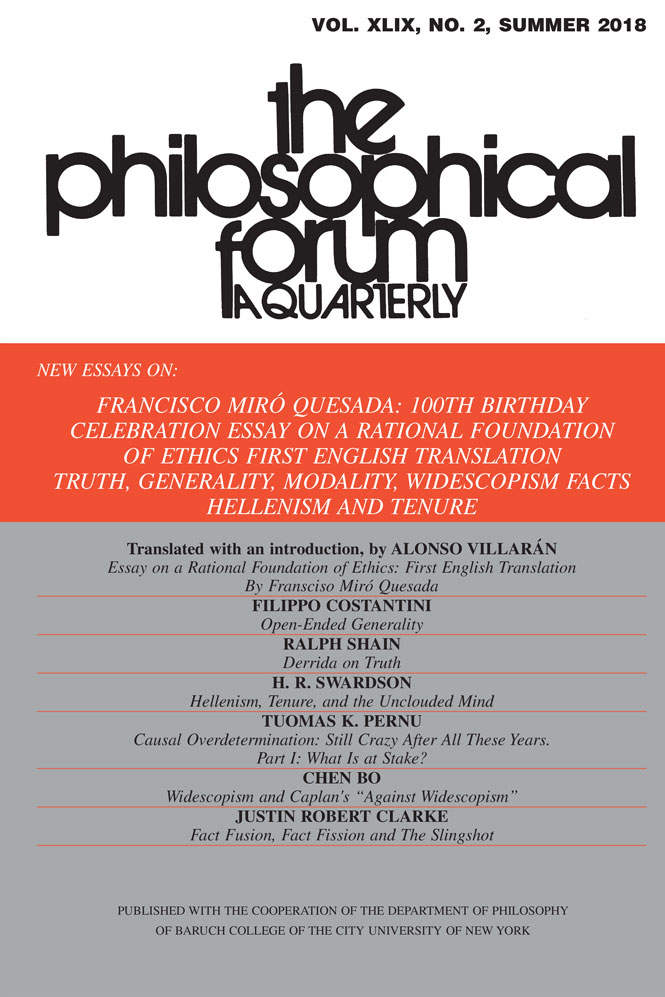
Cover image

My paper 'Propositions, Meaning and Names' is forthcoming in the Winter 2018 edition of The Philosophical Forum. It derives from a chapter of my PhD thesis and sketches an approach to the topics mentioned in the title. The approach to propositions and meaning it develops has other applications besides the question of the meaning of proper names, but that will have to wait (for the most part). This is my longest publication to date and is fairly ambitious. I've blogged here over the years about some of the ideas in it, and am glad to see them making their way to publication. It seems that philosophers who are especially interested in these topics often have to start from the beginning, and this is my start.

Thursday, 21 September 2017

A Dialogue on Mathematical Propositions

I wrote the following dialogue as an antidote to the dogmatism I felt myself falling into when trying to write a paper about a priori propositions. The characters A and B are present-day analytic philosophers. Roughly, A represents the part of me which wanted to write the paper I was working on, and B represents the part which made trouble for the project.

A: I've got a view about a priori propositions I'd like to discuss with you. I don't think you're going to like it.

B: Intriguing! I'll try to put up a good fight.

A: Good. Still, you won't just defend the opposite view no matter what, will you? I'm certainly going into this ready to modify my view, if not to completely relinquish it.

B: Sure. No, I won't just set myself up as an opponent debater. Let's try to give each other as much ground as our philosophical consciences allow, and see if we can agree on some things.

A: OK, great. So, here's the view: what is special about a priori propositions, which enables them to be known independently of experience, is that they have their truth values essentially. They do not reach outside themselves to get their truth values, but carry them within as part of their nature.

B: OK. Interesting use of the notion of essence. I'm used to associating views which tie a priori propositions' truth or falsity closely to meaning with more deflationary attitudes, not with philosophers who make positive use of metaphysical notions like that of essence.

A: Exactly. That's one of the exciting things about my view, I think. It brings out the fact that that sort of tight connection between meaning and truth value can be posited without embracing any problematic conventionalist or deflationary attitudes about essence or meaning.


B: I think you have a point there. A meaning-based view of a priori truth doesn't need to be deflationary or conventionalist. Still, I think it's wrong. Your view overlooks the fact that a priori propositions, or many of them at least, are about something, and we often have to inquire into that something to know them. When mathematicians discover new truths, they don't sit and try to get insight into the essences of the propositions they are wondering about. They try to get insight into the things that the propositions are about, like numbers, or sets, or graphs.

A: That is true, but does not affect what I am saying. Look, the a priori truths of mathematics either have their truth essentially, or accidentally. And if they really had to reach outside themselves for their truth, then they would only be true accidentally. And in that case it should be possible to depict those very propositions reaching out but getting the opposite truth value. But you can't even begin to imagine a situation where someone has expressed what is actually an a priori truth, but which in that situation is a false proposition. And it's not like the case of propositions whose instantiation vouchsafes their truth, like 'Language exists'. Instead, their truth is of their very essence. Now, we all agree that an a priori truth can have its actual truth value, but what would it look like for it to have the other one? The onus is on you to flesh out an answer here, and it seems to me that nothing you could say on this point would satisfy.

B: I do not dispute that I couldn't really flesh out a description of a situation where the same a priori proposition gets the opposite truth value, but I don't think I have to be able to. I can still maintain that these a priori truths do not have their truth off their own bat, due to meaning alone. The source of their truth lies in what they are about. However, unlike with empirical truths, what they are about is rigid and unmoving - necessarily the way it is. So it is no real objection that I cannot depict a situation in which their source of truth or falsity yields them a different truth value, since that is just because their source is necessarily the way it is. That doesn't make their source any less of a source.

A: So you are saying that the meanings of these a priori propositions are out there in a rigid, unmoving space of possible meanings, and that they get their truth or falsity from an equally rigid, unmoving space of mathematical objects. But since all this stuff is rigid, unmoving, and necessarily the way it is, it seems to me that your talk of sourcing is just empty talk. The very idea of sourcing seems dubious here. Granted, you may seem to have an advantage in the fact that our knowledge of these truths must have some source. But the sourcing you are talking about is all going on in Plato's Heaven. It does nothing to explain how we get the knowledge. So you might as well not posit it.

B: You are trying to cast aspersions on my talk of sourcing, but I want to suggest that what you are saying is, on examination, more dubious than what I am saying. You are no nominalist, no denier of the independent existence of mathematical objects. Right?

A: Sure. I mean, I think when people object to claims like 'Mathematical objects exist independently', they are perhaps bothered by something that really should bother them. But I do think that understood properly, such claims do make a sound and correct point.

B: OK, fine. And so, it seems to me that if you are saying that a priori truths about these objects have their truth essentially and off their own bat, you are positing a kind of harmony between the meanings and what they carry inside them on the one hand, and the mathematical objects on the other. But this harmony seems dubious. It cries out for explanation. Why should it exist? Coming around to the proper view, that the propositions are about the mathematical objects, and therefore the mathematical objects' being the way they are is the source of these propositions' truth values, the difficulty disappears.

A: I don't see how the harmony you complain about is particularly strange or objectionable. Don't parts of mathematics mirror and reflect each other in weird and wonderful ways? Since we accept that, it seems that it's not particularly costly to acknowledge that the meanings of mathematical truths are also part of this crystalline structure. Crucially, it seems less dubious than your sourcing talk - more of a piece with things we already acknowledge. And it seems to me that your view overdoes the analogy between mathematical and empirical truths, leading to confusion.

B: Do you see any positive value in your view? Or is it all about stopping that over-assimilation?

A: Well, perhaps my view helps with the problem of how we get mathematical knowledge. It seems to me an easier problem to say how we get in touch with meanings, than to say how we get in touch with things like numbers and sets. Our talk and thought instantiates meanings, I want to say, even if the meanings themselves are abstract, like numbers and sets.

B: But there are also "instantiation relationships", arguably more straightforward, between, say, numbers and piles of apples.

A: Hmm. Well, I don't know, I'll have to think more about that - but perhaps stopping the over-assimilation is enough. What value do you see in your view, anyway?

B: When I think about what is fundamentally wrong with your view, apart from my complaints about it being mysterious and ill-motivated, it seems to me that, in your effort to block the over-assimilation of mathematical and empirical propositions, you bring about another over-assimilation. Namely, between mathematical propositions which can be hard to discover the truth about, and what you might call paradigmatically analytic propositions - propositions where it really does seem that the way to know the truth about them is just to have insight into their meanings. Those propositions may perhaps be said to have their truth values essentially, since they don't seem to say anything substantial about anything, whether their subject matter be empirical or mathematical. And your view wrongly depicts substantial mathematical propositions as being like them. My view has the virtue of avoiding that over-assimilation. It may be that the over-assimilation you worry about is also a problem, but it should be combated in a different way.

A: Well, I am - or at least have been, up to having this conversation - inclined to think the corresponding thing about the over-assimilation that you are worried about. Positing a mysterious sourcing relationship between mathematical propositions and mathematical objects seems like a crude expedient. But I must acknowledge that the over-assimilation that bothers you is also a problem.

B: OK. So, it seems we can both agree that our respective views may have some power to prevent a certain over-assimilation, a different one in each case. And perhaps we can also agree that each of our respective views, when adopted, may increase the danger of falling into the over-assimilation targeted by the opposite view.

A: Hmm. I suppose we can both agree about that.

B: Now, isn't this worrying? I mean, where does it leave us? We have a question: Do mathematical propositions have their truth values essentially, intrinsically, inherently, off their own bat - or do they not? And it seems like our opposing answers have opposing strengths and opposing weaknesses. I feel the weakness of your view much more acutely, but I can't deny that your feeling that my view might be a somewhat crude expedient makes some sense as well.

A: I'm glad you're staying true to your intention of not just defending your view tooth and nail. Now it's starting to look like both our views have some merit, but that these merits crowd each other out. I am beginning to think that perhaps both our views can be said to suffer from crudeness on that score. We are both inclined to use a certain picture to ward off the over-assimilation which has most bothered us. And the pictures conflict, or at least seem to. Now, could it be that if our views were made clearer, these pictures could be seen to apply in different ways, so that there is no inconsistency in using one in its way, and the other in its way? The task then would be to clarify the difference between these two ways of using what appear to be conflicting pictures.

B: That is sounding more and more reasonable to me as a diagnosis of what's going on in this case. How Wittgensteinian! And to be honest, the Wittgensteinian-ness of this view worries me a bit, since this sort of approach, to this sort of problem, seems like it will turn many people off right away. If we are to try to resolve our difficulties this way, and if we expect the resolution to be given a fair hearing, I suppose we will also have to be careful to defend our resolution from objections which lump it together with features of Wittgenstein's views which people don't like.

A: I agree that is a worry. And it may be even worse than you are suggesting. What if the things people don't like and have turned their back on include this very power to resolve our difficulties!

B: Well, I see what you're saying. People are invested in a certain way of doing things, and in defending views of a certain type. And those ways of doing things may come naturally, at least to people with a certain background (including us), so that one slides back into them. But I think we may just have to try to give the naysayers about this method plenty of credit, and allow that there are serious problems with the sort of resolution we're talking about now. After all, why wouldn't there be? It could be that it's very promising, and still ultimately our best hope, but that there are serious difficulties with it which, in our desire to resolve our present issue, we aren't currently alive to.

A: I suppose I'm on board with what you're saying. As exciting and powerful as this approach may seem now, we must beware of coming off as if we think there's a silver bullet, a simple solution we've already got here. And I think that comes out more clearly when we come back from talking about pictures and consider the question, framed in terms of 'essence' or 'intrinsic' or what have you. Something about the idea of pictures makes us quite willing to allow different applications. Ambiguities, if you like. But it seems as though people, ourselves included, may be inclined to take a certain attitude to words like 'essence' and 'intrinsic', such that the word analogue of the move where we say 'These pictures appear to conflict, but if you look at their application, you see it's only an apparent conflict' seems less appealing. There is a feeling that with such words that for each there is a big, important, single job that they should be doing.

B: I think you're right. But again, I think you may be overplaying people's resistance. Yes, there will be people who just get turned off at the suggestion that such words should be understood as having various quite important roles to play. But probably, with many of the sort of people you have in mind, you must admit that they are willing to countenance such things as long as you keep things relatively clear and definite. I mean, if you start banging on about how complex and multifaceted it all is with these words, then yes, that will turn people off, because it sounds defeatist. It sounds like shirking hard and maybe very interesting work. But these sorts of people - and let's face it we're among them a lot of the time when we aren't just talking but trying to write papers - are quite willing to distinguish certain senses of weighty-seeming words, using little subscripts for example. So we shouldn't be too discouraged.

A: Yes, I suppose that's right. So, we should be ready to float the idea that our different pictures each having a role to play, but that just giving the picture and saying 'That's how things are' is a bit crude until we clarify and distinguish the application of the picture in each case. And we should be ready to try to take exactly this approach when it comes to our difficulties as posed in philosophical jargon, but be on guard against defeatist or wishy-washy sounding attitudes. I confess I'm worried about the extent to which this is possible. I mean, maybe once we try, we will find that the distinctions we might want to make by putting little subscripts on words like 'essence' tend to fall apart in our hands, or that possibilities multiply very quickly. But on the other hand, I must admit we haven't seriously tried yet. And maybe there is some progress to be made in that way, even if it does give out and get confusing again in a way similar to our original disagreement. So we should keep working on this.

B: Agreed.

A: I think I'm pretty worn out for now, though. And I suspect there are further problems with your view that I haven't brought out.

B: Same here, on both counts.

A: I hope we can find what it takes to continue soon.

B: So do I.

Saturday, 6 May 2017

The Pre-Kripkean Puzzles are Back

Yes, but does Nature have no say at all here?! Yes.
It is just that she makes herself heard in a different way.
Wittgenstein (MS 137).

Modality was already puzzling before Kripke - there’s a tendency for the potted history of the thing to make it seem like just before Kripke, philosophers by and large thought they had a good understanding of modality. But there were deep problems and puzzles all along, and I think many were alive to them.

There is a funny thing about the effect of Kripke’s work which I have been starting to grasp lately. It seems like it jolted people out of certain dogmas, but that the problems with those dogmas were actually already there. The idea of the necessary a posteriori sort of stunned those ways of thinking. But once the dust settles and we learn to factor out the blatantly empirical aspect from subjunctive modality - two main ways have been worked out, more on which in a moment - the issue comes back, and those ways of thinking and the problems with them are just all still there.

(When I was working on my account of subjunctive necessity de dicto, I thought of most pre-Kripkan discussions of modality as irrelevant and boring. Now that I have worked that account out, they are seeming more relevant.)

What are the two ways of factoring out the aposterioricity of subjunctive modality? There is the two-dimensional way: construct “worlds” using the sort of language that doesn’t lead to necessary a posteriori propositions, and then make the truth-value of subjunctive modal claims involving the sort of language that does lead to them depend on which one of the worlds is actual.

This is currently the most prominent and best-known approach. However, it involves heady idealizations, many perplexing details, and various questionable assumptions. I think the difficulty of the two-dimensional approach has kept us in a kind of post-Kripkean limbo for a surprisingly long time now. Except perhaps in a few minds, it has not yet become very clear how the old pre-Kripkean problems are still lying in wait for us. I have hopes that the second way of factoring out will move things forward more powerfully (while I simultaneously hope for a clearer understanding of two-dimensionalism).

What is the second way? It is to observe that the subjunctively necessary propositions are those which are members of the deductive closure of the propositions which are both true and C, where C is some a priori tractable property. (On my account of C-hood, the closure version of the analysis is equivalent to the somewhat easier to understand claim that a proposition is necessary iff it is, or is implied by, a proposition which is both C and true. On Sider’s account of C-hood this equivalence fails.)

My account of subjunctive necessity explains condition C as inherent counterfactual invariance, which in turn is defined using the notion of a genuine counterfactual scenario description. And it is with these notions that the old-style puzzles come back up. Sider’s account has it that C-hood is just a conventional matter - something like an arbitrary, disjunctive list of kinds of propositions. (Here we get a revival of the old disagreements between conventionalists and those who were happy to explain modality semantically, but suspicious of conventionalism.)

What are these returning puzzles all about? They are about whether, and in what way, meaning and concepts are arbitrary. And about whether, and in what way, the world speaks through meaning and concepts. Hence the quote at the beginning, and the quote at the end of this companion post.

Thursday, 29 September 2016

Are Meanings 'Individual Things'? An Important Unclarity in Lycan

I have recently been enjoying some of Lycan's papers, as well as his Philosophy of Language: A Contemporary Introduction. In Chapter 5 of the latter he writes:

In stating the foregoing meaning facts, I have at least half-heartedly tried to avoid “reification” of things called meanings; that is, talking about “meanings” as if they were individual things like shoes or socks.

'Like shoes and socks' how, though? The problem is: what does this mean?

Lycan then introduces the idea of 'entity theories':

Philosophers have made an issue of this. Let us use the term “entity theory” to mean a theory that officially takes meanings to be individual things.

And he goes on to contrast such theories with - you guessed it - 'use' theories, with the later Wittgenstein as the paradigm.

I think this is an unclear and misleading contrast. It is unclear what it takes to be an 'entity' or an 'individual thing'. The examples of shoes and socks may suggest that this notion is something like that of a physical object, or a 'concrete particular'. But that can't be right, as Lycan wants to count Fregean sense theories, or Moore's theory of propositions, for instance, as 'entity theories', but Fregean senses and Moorean propositions are not supposed to be physical, concrete things. Also, how are we to know what is official and unofficial? That distinction seems fishy here.

This contrast is misleading, I think, because it may suggest that the idea that meanings - or an aspect of them at least - should be thought of as roles in language systems, or uses of signs, commits one to some dark doctrine about these roles or uses not being 'individual things'. Which, as I have suggested, has no clear meaning. This may then marginalize this sort of role/use idea about meaning, for example by making it look as though it is automatically in contradiction with any technical semantic theory which maps expressions to entities of some sort.

I suggest that the real point in this neighbourhood, regarding a role/use conception of meaning, is not that on such a conception, meanings aren't entities, or individual things - whatever that means - but that they are, speaking loosely, 'things' in a quite particular, easy to misunderstand sense. In Wittgensteinian terms, the grammar of expressions like 'the meaning of that utterance' must be attended to, and our understanding of it not simply modelled on that of expressions which function very differently, say, 'the bearer of that name' or 'this shoe'.

Reference

Lycan, William G. (1999). Philosophy of Language: A Contemporary Introduction. Routledge.

Saturday, 15 August 2015

The Principle of Compositionality and Semantic Granularity

This is another post in my series on semantic granularity. The others so far, in chronological order, are:


If meanings properly get carved up at different granularities, as I maintain, what are the implications for the 'the principle of compositionality'? I believe that granularity considerations can shed light on the status and application of this principle, and clear up much of the confusion surrounding it.

This confusion appears to be considerable. Witness Daniel Cohnitz ('Is Compositionality an A Priori Principle?'):

A superficial look at the literature on the principle of compositionality [...] could suggest that the discussion is as confused as a discussion can be.

I will now quote some classic and some typical formulations of the principle, and then indicate what we can say about it in light of granularity.

From the Tractatus:

I conceive the proposition—like Frege and Russell—as a function of the expressions contained in it. (3.318)

To understand a proposition means to know what is the case, if it is true.
(One can therefore understand it without knowing whether it is true or not.)
One understands it if one understands its constituent parts. (4.024)

It is essential to propositions, that they can communicate a new sense to us. (4.027)

Frege, in a letter to P.F. Jourdain, probably written in 1914:

The possibility of our understanding [my emphasis] propositions which we have never heard before rests evidently on this, that we construct the sense of a proposition out of the parts that correspond to the words.

Theo Janssen, 'Compositionality':

The principle of compositionality reads, in its best known formulation:
The meaning of a compound expression is a function of the meanings of its parts.

But this omits something. The way the parts are put together, not just their meaning, goes into determining the meaning of the whole. ('John loves Mary' means something different from 'Mary loves John'.)

This is the point made by 3.141 of the Tractatus:
The proposition is not a mixture of words (just as the musical theme is not a mixture of tones). 
The proposition is articulate.

The following instances do not omit this:

B.H. Partee, handout for Ling 310 The Structure of Meaning, Lecture 1, February 20, 2006 p.1:

The Principle of Compositionality: The meaning of an expression is a function of the meanings of its parts and of the way they are syntactically combined.

'Compositionality', The Stanford Encyclopedia of Philosophy:

[T]he meaning of a complex expression is fully determined by its structure and the meanings of its constituents.

We have now seen the principle of compositionality stated in various ways.

One idea I want to suggest is that, at a maximally fine granularity, the principle of compositionality can be thought of as guaranteed to hold – a blanket, a priori principle.

However, once we relax the granularity, compositionality can begin to fail in many cases.

This would give us an avenue by which to approach the confusion about whether the principle of compositionality is just a conceptual truth about how all languages – everything we would call a language – must work, or an ideal which is sometimes met and sometimes not, or just something which occurs sometimes (i.e. for some languages, or parts of languages) and not others, without necessarily being an ideal: from a fine-grained point of view, it can be construed as something which applies without exception, but from courser-grained points of view, we can make distinctions between cases where it holds and cases where it doesn't. (The stuff about being an ideal versus not being an ideal can then be considered using this as a basis.)

The proposal I just indicated – that at a maximally fine granularity, compositionality can be thought of as holding a priori and across the board – while it has a certain theoretical appeal, is problematic: it might seem straightforwardly false (in light of the existence of idioms, for example), but of course replies can be made to that (for example, that semantically, idiomatic phrases have less, or just different, parts or constituents than they would appear to have considered literalistically). I do not want to be dogmatic about this, and I suspect there is room for “having it both ways” by means of careful disambiguation.

Some of the points I want to make here can be made without any such strong principle (that is, without the proposal above – call it 'the blanket proposal'). I will therefore do that first, and then come back and reconsider the blanket proposal.

Compositionality Can Depend on Granularity

The proposal summed up in this heading is weaker than the blanket proposal (the proposal that granularity holds a priori across the board at maximally fine granularity but can fail in cases as the granularity is coarsened): all that is claimed is that some complex expressions are such that compositionality may be said to hold of them, given a certain granularity of individuation of their components' meanings, but also such that compositionality then fails to hold at a coarser granularity.

Consider this bit of dialogue from season 2 of Flight of the Conchords:

Murray: Now, we've known each other for quite some time in the professional realm. I'd like to push things forward in the friendship realm.

Jemaine: What's the friendship realm?

Murray: Well, you've heard of a realm?

Bret: Mm.

Murray: Yep?

Jemaine: Yes.

Murray: Well this is like a friendship one.

What makes this sequence is the way Murray's compositional "explanation" of 'the friendship realm' fails drastically. Is this, then, a “counterexample to compositionality”? Not really; or at least, to say that would not be to tell the whole story.

I think we can take two views of this case, and many others like it: a compositional/fine-grained view and a non-compositional/course-grained view.

On the first conception, we think: Murray means something here, he has put together a meaningful proposition. 'Friendship' and 'realm' here are clearly functioning in a way that is continuous with and related to a great many other occurrences of these words. Therefore, whatever this proposition means, that 'friendship' and 'realm' contribute in the way they do, or that they appear here in the way they do, in a proposition with this meaning, is part of – or an aspect of – the meaning, or the use, of these words (given fineness of grain).

Taking this viewpoint does not commit us to saying that these fine-grained component meanings were fully present before the phrase 'friendship realm' was ever used: depending on the details of the case, we could say that some people attached those meanings to the component terms already and some attached others (but that the difference never showed up, or slightly, but not in such a way as to prevent mutual understanding), or that no one used the words with exactly those meanings before the phrase was used, but that they were spontaneously arrived at when the phrase was coined (and understood, if we change the case and suppose it was understood by Jemaine and Brett, as would be more likely in real life) – that is, the meanings of 'friendship' and 'realm' were spontaneously and slightly extended.

On the second conception, by contrast, we think: 'friendship' and 'realm' are familiar words, and they were both presumably around for a long time before 'friendship realm' was ever used. Putting these two meaningful words together, however, doesn't all by itself yield one and only one possible meaning. There is room for going different ways here. ('The friendship realm', for instance, might be used differently from how Murray uses it, to mean some mythical realm in which everyone is friends.) Of course, when 'friendship realm' does end up meaning some particular thing, this will not be unrelated to 'friendship' and 'realm' – they guide the meaning, without determining it. The gap between what they provide and the meaning of 'friendship realm' must be filled by semantic developments pertaining to 'friendship realm'. But we needn't say that these developments affect the meanings of 'friendship' and 'realm' taken by themselves – we can maintain that they haven't taken on new meanings.

(It may be that compositionality doesn't necessarily fail according to this second conception: perhaps the gap between what the pre-existing meanings of 'friendship' and 'realm' and a meaning for 'friendship realm' can be thought of as being filled by a structure or mode of composition, if we construe this as going beyond surface syntax.)

Now, what does this get us, i.e. what does it get us to see that there is all this room for manoeuvring here?

One thing it gets us is a way of explaining a large class of putative counterexamples to the principle of compositionality, without denying any natural point of view. In fact, we have before us two ways of accounting for the idea that this is a counterexample to compositionality. Rather than two equally good ways of accounting for exactly the same thing, I think they cover different sorts of cases, different instances of the idea that this is a counterexample to compositionality; compositionality can be said to fail here in two senses:

(1) While compositionality may be said to hold at a very fine granularity, it can be said not to hold at a coarser one. So, one thing that might be going on when we think we have a counterexample to compositionality is that we are operating at a granularity at which it is a counterexample – and if someone disagrees, we might be talking at crossed granularities.

(2) A dynamic, temporal sense. We make no bones about the fact that now we have some new complex expression, we can say that the meanings of its parts, plus its structure, determines the meaning of the whole. (Thus we are operating at the finer granularity.) But we insist that when it was introduced, its meaning wasn't so determined: rather, it induced spontaneous semantic development. So, we can call a use of language non-compositional in this sense if it involved such development – and we may relativize this to a thinker or speaker, a listener, etc. Something compositional for me might be non-compositional for you at first, but my saying it induces spontaneous semantic development on your side so that it becomes compositional after the fact. We might use 'dynamic compositionality' for this idea; when spontaneous semantic innovations occur involving complex expressions, we can say that those expression uses were dynamically non-compositional.

Neither sense conflicts with the claim that, at fine-grain and timelessly, 'friendship realm' and similar cases are perfectly compositional.

These considerations may also shed some light on the issue of whether, or in what circumstances, compositionality is to be regarded as an ideal to be striven towards, if not attained. In some cases, we may have as an ideal that no spontaneous semantic innovation – no guesswork, we might say, from an interpreter's perspective – be required for a certain language-game (use of language), for example in parts of science, certain personal encounters, or in parts of legislature. That is, dynamic compositionality may be desired. But it is just as clear that sometimes we want dynamic non-compositionality.

Or we might want a language, or a part of language, to be so simple that there is no room for granularity shifting: each expression has a couple of clear rules attached to it, and if you change any of them, it's just not natural to say that the meanings stayed the same. We might be able to ensure this by laying it down that compositionality must not fail. (If we're aware of granularity considerations, we might say 'must not fail at any reasonable granularity', but we need not be aware of them to pull off the trick.)

So, the above considerations get us a few things. What remains?

We have seen that many cases where compositionality seems to fail – such as Murray's use of 'friendship realm' – may be explained away by saying: if you individuate the components' meanings at a finer granularity, this is no longer a counterexample. But the question remains: can that be done in every case? That is, does the blanket proposal hold?

By getting clearer about the blanket proposal, we will get clearer about the nature or meaning of the principle of compositionality. In this connection, we should consider idioms, metaphors and similes, sarcasm and the like, and semantic “outgrowths” like 'Wednesday is fat' and 'The letter a is yellow'.

Such linguistic phenomena also suggest that there may be more to say about the notion of compositionality as an ideal.

The Blanket Proposal

A proponent of the blanket proposal might say that, when compositionality fails, we have decided to bundle together as having one meaning expressions, or possible occurrences of expressions, which on a more fine-grained conception would be regarded as having (perhaps only slightly) different meanings. But is this really plausible in every case?

Here are some difficult types of cases:

Idioms: Consider phrases like 'spitting image', 'dead ringer', 'nest egg', 'piece of cake', 'funny farm', 'loose cannon', 'no dice', 'from scratch', 'kick the bucket'.

Propositions like 'He is a loose cannon'

'Pull strings' a bit more flexible. Frozen metaphor.

Sarcasm and the like: A sarcastic utterance of 'That's just great' may seem to be a kind of counterexample to compositionality: what is meant is that something is terrible, but this depends not just on the meanings of the components and how they are put together, but also on the context: it might be meant non-sarcastically.

But we can invoke an intensional (internal semantic) analogue of Kripke's distinction between speaker's reference and semantic reference here, and insist that what this expression means, even in the sarcastic use, is that the thing in question is very good, even though what the speaker means by it is something else.

From the point of view of expression-meaning, then, sarcasm and the like do not threaten compositionality in the least. But there is nothing stopping us talking about compositionality in connection with speaker-meaning, and saying that it fails in this case ('That's just great').

Or, we may say that what the speaker means by the whole is determined by what the speaker means by the parts, together with their mode of composition, by maintaining that by 'great' the speaker means 'terrible'.

But other cases seem different. Suppose someone takes something to be very obvious, but, by way of parody of some other group who may doubt it, might sarcastically say, 'Of course, empirical studies may prove me wrong' (let's suppose they're quite nerdy). Here, the meaning is something like 'Come on, we know this!', but the sarcasm cannot be located, so to speak, in any particular phrase. The whole construction is bound up with the sarcasm – what is literally meant cannot aptly be stated using the same syntactic form, only negated (e.g. 'Of course, it's not the case that empirical studies may prove me wrong', or some other placement of negation).

For now I remain agnostic.

A Final Observation about Wholes and Parts and Granularity

Observation: Two propositions - or more generally, complex expressions - can be identical in meaning at one granularity, while none of their parts have the same meaning at any reasonable granularity. Or less extremely, while few of their parts, or none of their "key words", have the same meaning at any reasonable granularity. Or again, while their overall structure and arrangement of parts is quite different.

For example: 'Get out!' and 'Leave at once!'.

Sunday, 12 July 2015

An Account of the Analytic/Synthetic Distinction

Some of the intuitive characterisations given, in the last post, of the notion of internality of truth-value – such as 'internal meaning determines truth-value' - sound a lot like a common post-Kantian way of characterising or defining analyticity, namely as 'truth in virtue of meaning'. This raises the question of whether the class of a priori truths is the class of analytic truths, and the question of whether there are, or should be, distinct notions here at all. My answers to these questions will be No and Yes respectively.

The aim here will be to try to clarify an interesting notion of analyticity which is conceptually and extensionally distinct from all the notions of truth a priori identified in the last post (internality of truth, non-Twin-Earthability of truth, Chalmers' epistemic two-dimensionalist account, and traditional conceptions). It is distinct from, but builds on, our internality conception of the a priori.

The account I will give of this notion is inspired by Kant's account of the analytic-synthetic distinction in the Critique of Pure Reason, as well as Wittgenstein's remarks on the synthetic a priori and concept-formation in the Remarks on the Foundations of Mathematics.

It is well known that Kant's definition, or principal explication, of 'analytic' and 'synthetic' is given in terms of subject and predicate:

In all judgments wherein the relation of a subject to the predicate is cogitated (I mention affirmative judgments only here; the application to negative will be very easy), this relation is possible in two different ways. Either the predicate B belongs to the subject A, as somewhat which is contained (though covertly) in the conception A; or the predicate B lies completely out of the conception A, although it stands in connection with it. In the first instance, I term the judgment analytical, in the second, synthetical.

Since modern logic and philosophy of language has taught us not to regard every proposition as being composed of a subject and a predicate, this definition can't be adequate for us. But it is suggestive, and even moreso are some of the other things Kant says about the analytic-synthetic distinction. He says of analytic and synthetic propositions respectively that 'the former may be called explicative, the latter augmentative'. And consider this elaborated version he gives of his main question, that of how synthetic a priori knowledge is possible: 'If I go out of and beyond the conception A, in order to recognize another B as connected with it, what foundation have I to rest on, whereby to render the synthesis possible?'.

The idea that synthetical judgments are 'augmentative', that they 'go out and beyond' 'conceptions', can, I think, be generalized or abstracted from Kant's discussion in such a way that it does not depend on construing all propositions as being of the subject-predicate form. And we get a hint of how to do this from the following passage about the syntheticity of the proposition '7 + 5 = 12':

We might, indeed, at first suppose that the proposition 7 + 5 = 12 is a merely analytical proposition, following (according to the principle of contradiction) from the conception of a sum of seven and five. But if we regard it more narrowly [my emphasis], we find that our conception of the sum of seven and five contains nothing more than the uniting of both sums into one, whereby it cannot at all be cogitated what this single number is which embraces both. The conception of twelve is by no means obtained by merely cogitating the union of seven and five; and we may analyse our conception of such a possible sum as long as we will, still we shall never discover in it the notion of twelve. We must go beyond these conceptions, […]

This regarding-more-narrowly will be the key for us. We said above that a proposition is a priori iff it contains its truth value, i.e. iff its internal meaning determines its truth-value. Our idea now is that a proposition is analytic iff its internal meaning regarded more narrowly in a certain way – or iff a certain sort of part or fragment of its internal meaning – determines its truth-value. And so the next task is to try to clarify what characterises the aspects of internal meaning we are restricting our attention to here.

To do this, we will use the notion of concept- or conceptual-structure-possession, and the notion of understanding. We will not need to involve considerations of knowledge, judgement, being-in-a-position-to-see-that, or anything like that. (Later, we will consider how what we say may shed light on accounts which do involve such considerations.)

As a first approximation, we will say that a proposition is analytic iff the bits of conceptual structure – the part of its internal meaning - one must possess in order to understand it, determines its truth-value. (This involves a terminological departure from the possibly more common procedure of regarding analyticity as implying truth – we say that an analytic proposition can be true or false, just as we say an a priori proposition can be true or false. This has the nice feature of giving us a simple division among propositions in general, not just truths, so that we can say that for propositions in general, being analytic is just not being synthetic, and vice versa.)

We can make this definition easier to handle and more memorable by giving it in two parts:

The meaning-radical of a meaningful expression consists in the bits of conceptual structure, i.e. the part of its internal meaning, one must possess in order to understand it.

A proposition is analytic iff its meaning-radical determines its truth-value.

(As an added bonus, we now have the general concept of a meaning-radical, which we can apply to sub-propositional expressions as well as propositions, and perhaps also to super-propositional expressions such as arguments.)

Consider the fact that we can come to believe false arithmetical propositions - for example on the basis of miscalculation, or misremembering, or false testimony - and that we can apply them.

Contrast the case of a paradigm analytic proposition, such as 'All bachelors are unmarried'. (To get around the irrelevant problem that in English 'bachelor' very arguably doesn't mean 'unmarried man', let us just suppose that it does mean exactly that.) To be sure, someone can assent to the sentence 'Not all bachelors are unmarried', and dissent from 'All bachelors are unmarried', but in such a case we would say that they don't understand this latter as we do – they don't understand our proposition 'All bachelors are unmarried'. So they don't believe – and here we are using words with our meanings kept intact – that not all bachelors are unmarried.

Kant says that we can become 'more clearly convinced' of the syntheticity of arithmetical propositions 'by trying large numbers'. Let us now, therefore, try to illustrate the notion of a meaning-radical, and in turn that of analyticity, by considering an example of a false arithmetical proposition involving numbers larger than 7, 5 and 12. Say '25 x 25 = 600'.

Despite being false a priori, the proposition '25 x 25 = 600' is something we can mistakenly believe and apply while still understanding it correctly (in some suitably minimal, and natural, sense of 'understand'). We have – wrongly – made a connection between our conception of the product of 25 and 25, and our concept of 600.

Why do we say that we understand the proposition in its ordinary sense and are wrong, rather than saying that we are operating in a different system, in which the sentence '25 x 25 = 600' is true, and that we (therefore) don't understand the proposition in its ordinary sense? It is not hard to see what sorts of things make it that way. If we worked it out on a calculator, or calculated it again ourselves, we would unmake the connection. Such developments would show that we did understand the proposition correctly (i.e. in its ordinary sense).

(Suppose an illegal move is made in chess, say that someone moves their king into check (so that it need not be immediately obvious that it is an illegal move). If the maker of this move can easily be brought to accept that their move was illegal, we can maintain that they understand how to play chess and were playing it according to the ordinary rules, but playing wrongly. If they cannot, then either they simply do not understand chess, or are insisting on playing according to deviant rules.)

The fact that in the case of the false belief that '25 x 25 = 600', there is this other option here, if I may put it that way, of saying that we are operating in a different system – an option which we will have to reject because of many things about how things are, so in that sense not an option, but still something which makes sense – shows that there is a possible system, compatible with the meaning-radical of '25 x 25 = 600', in which that sentence holds. That is, the meaning-radical of '25 x 25 = 600' – that bit of conceptual structure – can be incorporated into a larger structure wherein the concept of the product of 25 and 25 (although we might not want to call it that anymore) is connected to that of 600 in such a way that the sentence '25 x 25 = 600' is true. It will have a different internal meaning from our proposition '25 x 25 = 600', despite the system it belongs to incorporating the meaning-radical of our proposition. This is what makes '25 x 25 = 600' synthetic.

On this picture, the full internal meaning of a concept or proposition-meaning may involve connections which do not have to be made in order to understand it.

So, a proposition is analytic iff it has its truth-value in virtue of the bits of conceptual structure someone has to possess in order to understand it. That is, iff the bits of conceptual structure one must have in order to understand it cannot be embedded in a context such that the proposition-radical of that proposition gets a completion such that the resulting proposition has a different truth-value from the proposition in question.

More briefly, a proposition is analytic iff its meaning-radical determines its truth-value.

All a priori propositions, then, on the account I am giving here, will be such that their internal meanings determine their truth-values. But analytic propositions have the further property that their radicals determine their truth-values, whereas the radicals of synthetic a priori propositions can be incorporated into both true propositions and false ones.

A Complication

One complication: perhaps there is a mistaken assumption of uniqueness built into my talk above of the meaning-radical of a proposition. The bit of conceptual structure one must possess in order to understand it. Perhaps one and the same proposition can be understood from more than one angle, as it were, in which case it may be better to talk about multiple meaning-radicals – distinct bits of conceptual structure all of which individually and minimally suffice for understanding.

This gives rise to a choice: if that's how things are, should we call the analytic propositions those which are such that all their meaning-radicals determine their truth-values? Or those which have at least one meaning-radical which determines their truth-value?

I do not want to try to settle the issue of whether we should recognize a possibility of multiple radicals. Furthermore, I have no opinion about which use of terminology is best, in case we should – perhaps it just doesn't matter. If we use 'analytic' for the first, we may say 'weakly analytic' for the second. Or, if we use 'analytic' for the second, we may say 'strongly analytic' for the first. Or we might make 'analytic' mean 'either strongly or weakly analytic'. Or drop it entirely, and always specify 'strong' or 'weak'.