Showing posts with label propositions. Show all posts

Friday, 13 December 2019

Tractarian Propositions and Taking the 'X in Y' Construction Seriously

This is a sequel to the previous post, in which I continue to react to interesting recent "cognitive act theories" of propositions championed by Soames and Hanks, and work out my own views in relation to them.

In Soames's recent article on the Tractatus, he argues that Wittgenstein's conception of a proposition - that it is a propositional sign in its projective relation to the world - is incoherent. Soames's idea is that this doesn't actually specify a thing over and above the propositional sign. Just as Soames-in-relation-to-his-wife (one of his examples) isn't actually a separate thing or person from Soames, a propositional sign in its projective relation to the world isn't actually something other than the propositional sign. It is not some "larger" entity which includes the propositional sign as a part.

This then leads Soames to propose, on the basis also of a remark in the Tractatus that our thinking the sense of a proposition is our putting it in relation to the world, that Wittgenstein would have been better off identifying propositions as propositional signs together with cognitive acts. And this is similar to his own recent theory of propositions, on which they are just cognitive acts in abstraction from any particular signs. 

In this way, Soames presents Wittgenstein as groping toward a better view of the nature of propositions - better than those of Frege and Russell, for whom propositions were Platonic things independent of language use - and offering a more coherent way of doing this.

Recently Peter Hanks has argued that there is another way here: that we can instead look at the (to me confusing and confused) idea in the Tractatus that a propositional sign is a fact. (This is something Wittgenstein later came to think of as a category mistake - but the new act theorists of propositions are generally disposed to be less keen to convict philosophers of category mistakes. After all, the view that a proposition is an act - a thing done - itself sounds like a category mistake. So we're in a pocket of philosophy where there's a fair amount of tolerance of what can seem like category mistakes, being explained away in terms of unimportant intuitions that should be overcome as we better systematise out thinking.) Looking at it that way, Hanks argues that the propositional sign in its relation to the world may be seen as a "larger" fact which involves the fact that is the propositional sign, but where the elements of that sign/fact that are related to one another are also related to further elements, things out in the world. 

I share Hanks's sense that Soames's argument against the coherence of Wittgenstein's conception of propositions and how they relate to propositional signs is surmountable. But I confess that the idea of a sign as a fact has never appealed to me, and really does seem like a category mistake. 

I think there's a third way to understand this talk of a proposition being a propositional sign in its projective relation to the world. It may even be more faithful to the Tractatus, but maybe not. I think it probably is more faithful to Wittgenstein's ideas as they developed after the Tractatus though. More importantly, I think it may be the best way of thinking about these matters.

Soames complains that a thing in some relation isn't actually a separate thing. And this is meant to be an objection to the Tractarian notion of a proposition, the idea being that propositions are meant to be distinct things from propositional signs. 

But who said they had to be? The objection I have to both Soames's and Hanks's reconstructions of the Tractarian idea is that they both look for a way to avoid taking the 'X in Y' construction seriously, whereas part of what makes it a truly radical and fruitful idea may get lost that way. (The new act theorists want propositions to be inherently representational things. But perhaps part of Wittgenstein's thinking is that really we have signs, and we use them, and it is only in those uses that they bear representational properties and properties like truth. And so looking for a further object over and above the sign is unnecessary, and even a mistake.)

Now, there are different ways to think about how this conception can be expressed, and how expressions of it can be decomposed. You might think of it this way: there's a complex sign, which may get used in two different language systems. Then you might think that this sign is true in one of its projective relations to the world, and false in another. Here the 'in projective relation R' becomes part of the predicate, like 'true-in-L' in discussions of Tarski. But you can also put it into the subject, 'The sign in relation R' and then predicate truth of the sign in that relation. Is this a further entity over and above the sign? You can think of it that way, but perhaps there's another way here, where we just have the property of truth - not some more complicated projective-relation-involving predicate - and we just have the sign as our main entity. But we nevertheless predicate truth not of the sign simpliciter but we predicate it of the sign in a particular projective relation to the world. On this conception, it's not that we have an augmented predicate or a thing over and above the sign, rather we're just using a logical form which isn't just a simple subject-predicate proposition of the sort whose truth conditions can be given as: the proposition is true iff the property expressed by the predicate is possessed by the entity denoted by the subject. To squeeze the Tractarian conception of propositions into that form is to water it down. In particular, it is to water down its ability to get around the problem laying at the foundation of the new act-based theories of propositions - the problem about propositions needing to be inherently representational. Taking the Tractarian idea of a proposition more seriously, we don't have to find a thing that is inherently representational and then put that at the basis of our theories. We may insist that the primary truth bearers really are signs, but that these signs only bear truth in use, and that a given sign can bear truth in one use and falsity in another. 

References

Hanks, Peter (2019). Soames on the Tractatus. Philosophical Studies 176 (5):1367-1376.
Soames, Scott (2016). Propositions, The Tractatus, and "The Single Great Problem of Philosophy". Critica 48 (143):3-19.

Sunday, 8 December 2019

Against Inherently Representational Anything

Soames, in his fascinating recent work Rethinking Language, Mind, and Meaning, begins by posing a problem for the study of meaning and language as developed by philosophers and logicians in the Twentieth Century.

For propositions to play the theoretical roles assigned to them - such as being the primary bearers of truth, being the objects of propositional attitudes like belief and desire, being the contents of mental and perceptual states, and being the meanings of some sentences - they, Soames says, must be inherently representational. That is, they must impose conditions on the world off their own bat, so to speak. 

But, argues Soames, the sorts of things that traditionally play the proposition role in modern theories do not seem to be inherently representational. Soames provides 'reasons to believe that no set-theoretic construction of objects, properties, world-states or other denizens of Plato’s heaven, could ever be inherently representational bearers of truth conditions in this sense' (Rethinking, Ch. 2).

This leads Soames to his new theory of propositions, on which they are cognitive acts of a certain kind. ('Suppose, however, we start at the other end, taking it as an uncontested certainty that agents represent things as being certain ways when they think of them as being those ways' (Rethinking, Ch. 2).) For example, the proposition that snow is white, on Soames's theory, is the act of predicating whiteness of snow. These cognitive acts, according to Soames, are inherently representational, which means that they could be able to play the role of propositions. 

(Soames says that, at bottom, it is language users that represent things as being certain ways, and they do this by performing cognitive acts, which acts may derivatively be said to represent. But although, in this way, they represent in a derivative sense, they do so inherently - and that is the crucial point for Soames, that makes cognitive acts fit to play the role of propositions.)

I am very heartened to see Soames realising that his earlier, broadly Russellian conception of propositions won't do and looking for an alternative. But his cognitive acts seem a bit mysterious to me. In this note I won't try to refute Soames's new theory of propositions, but let me say something briefly about what worries me. It's not so much that I think that there's no such thing as the cognitive act of predicating whiteness of snow, but I don't feel like this is the sort of thing that is fit to play the sort of basic explanatory role that Soames wants it to play. It feels too much like a black box containing important workings for that. Treated as something basic, it feels occult or magical. (Wittgenstein in the Investigations seems very concerned to avoid positing mental goings-on that are meant to play this kind of foundational role in explaining representation. This has influenced me and I think there's something right about Wittgenstein's conviction that this is not the way forward.)

There is another conception of propositions, on which they are sentences (of a certain kind) in use (or a certain kind of use). For instance, in the Tractatus Wittgenstein said that a proposition is a propositional sign in a projective relation to the world. (In a recent paper I sketch an account of propositions that treats them similarly.)

(Of course, it is nice to be able to say what two synonymous sentences in different languages have in common, and often it is said that they 'express the same proposition'. On the present approach, they may be said to have the same use, the same meaning. But ultimately it is not just the use or the meaning that represents - it is a sign in use, a sign with meaning, that does this. The "proposition" or "statement" or whatever you call it that two different sentences express is an abstraction from the particular propositions that are alike in meaning.)

It seems to me that this fundamental logical move of treating propositions not as things by themselves, as it were, but a certain kind of thing in a certain kind of context is very important, and constitutes the right way to avoid the twin pitfalls of having propositions be things that don't themselves represent, and of having them be explanatorily basic cognitive acts. 

Admittedly, sentences in use can't just be slotted in to all the roles Soames delineates without further ado. For instance, we probably don't want to say that if you believe something - perhaps without even representing it to yourself linguistically - the thing you believe is a sentence in a particular use. Soames's theory may have an advantage over my approach here in having this one kind of thing - propositions - playing all of these roles (although I doubt it, since Soames's theory has predictions which sound like category-mistakes, such as that one may 'perform a proposition', propositions being acts according to this theory). But I think that ultimately such a theory with one single sort of thing playing all these diverse roles will not be attractive overall, and that we may have to refine the picture somewhat of how these things like sentence meaning and the objects of belief relate to each other. I am focusing for now on linguistic meaning.

Sentences in use, you might say are 'inherently representational': but the whole idea of inherence doesn't really fit here. The whole point is that sentences are not inherently representational, but used in certain ways, they are. If you want to treat the sentence-in-use as a sort of thing by itself, then this is a kind of abstraction. Such a logical construction may be useful, but the resulting entity is not explanatorily basic: underneath, you have the sentence and you have all the stuff about how it is used. And so, at the base level, you don't have anything inherently representational.

This approach fits naturally with the ideas of representing and of a representation. Fundamentally, a representation itself is just a concrete thing - like a drawing or a sentence. And it represents not inherently, but by being used in a certain way. People represent things as being certain ways by putting representations to use.

This approach also furnishes a kind of explanation of the feeling of occultness or suspiciousness in theories which posit inherently representational entities in their explanatory base: they feel unsatisfactory because they hide the contextual rabbit in the hat of some posited object. If we are forced to treat this object as basic, we can never see under the hat.

References

Haze, Tristan Grøtvedt (2018). Propositions, Meaning, and Names. Philosophical Forum 49 (3):335-362.

Soames, Scott (2015). Rethinking Language, Mind, and Meaning. Princeton University Press.

Wittgenstein, Ludwig (1922). Tractatus Logico-Philosophicus. Routledge & Kegan Paul.

Wednesday, 20 June 2018

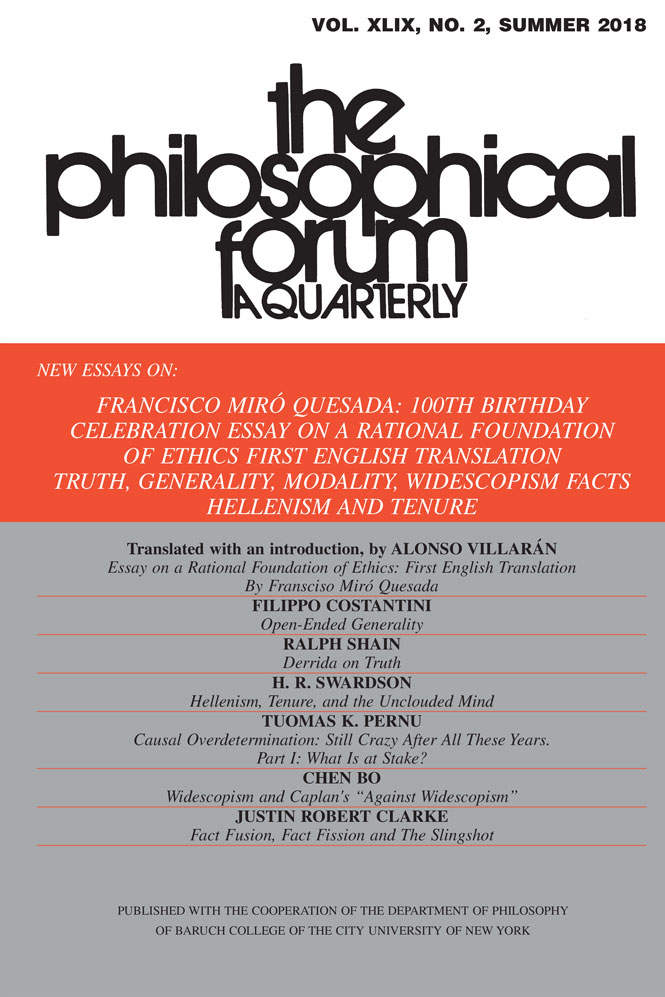
Forthcoming in The Philosophical Forum

Cover image

My paper 'Propositions, Meaning and Names' is forthcoming in the Winter 2018 edition of The Philosophical Forum. It derives from a chapter of my PhD thesis and sketches an approach to the topics mentioned in the title. The approach to propositions and meaning it develops has other applications besides the question of the meaning of proper names, but that will have to wait (for the most part). This is my longest publication to date and is fairly ambitious. I've blogged here over the years about some of the ideas in it, and am glad to see them making their way to publication. It seems that philosophers who are especially interested in these topics often have to start from the beginning, and this is my start.

Sunday, 1 November 2015

What is Necessity De Dicto?

I recently posted an account of necessity de dicto. The purpose of this post is to pin down exactly what this topic is. The notion in question of course looms large in contemporary analytic philosophy, but it will serve us well and keep us grounded to furnish in as clear a way as possible a basic characterization of it. In a future post, I will turn to specifying the problem or task which my account is addressed to with respect to the topic. In another future post, I will state some of my assumptions and guiding ideas.

The key source for the notion of necessity de dicto is of course Kripke's Naming and Necessity. It was there that our topic was (to the best of my knowledge) first clearly isolated and characterized. Priority aside, Kripke's characterization is not easily improved upon and has been very influential. (Regarding the notion itself, not its characterization: it is a very interesting historical question to what extent this notion was present in earlier thinking. Or to what extent similar notions were, and how they may relate to the present notion. I will make no attempt here to answer this.)

Kripke's starting-point in characterizing the notion of necessity de dicto is to remark that, while many (at the time he was speaking) seem not to differentiate between a priority and necessity, he certainly will not use 'a priori' and 'necessary' in the same way (p. 34). He then, after emphasizing that the notion of a priority is an epistemological one and mentioning some issues which might arise with that notion, gives the following characterisation of necessity:

The second concept which is in question is that of necessity. Sometimes this is used in an epistemological way and might then just mean a priori. And of course, sometimes it is used in a physical way when people distinguish between physical and logical necessity. But what I am concerned with here is a notion which is not a notion of epistemology but of metaphysics in some (I hope) nonpejorative sense. We ask whether something might have been true, or might have been false. Well, if something is false, it's obviously not necessarily true. If it is true, might it have been otherwise? Is it possible that, in this respect, the world should have been different from the way it is? If the answer is 'no', then this fact about the world is a necessary one. If the answer is 'yes', then this fact about the world is a contingent one. (pp. 35 – 36.)

This should go a long way to giving us an acceptable grasp of the notion of necessity de dicto. Kripke also says some things about the extension of the notion which may be of further help to this end. Before proceeding to that, however, I want to tighten up Kripke's characterization in a couple of ways, as well as emphasizing and de-emphasizing certain parts of it.

For one thing, note that Kripke moves freely here between talking of 'facts about the world' as well as things which can be called true or false, as the bearers of necessity. Later, he speaks also of 'states of affairs' and 'statements'. This is fine, but I want to make it clear that the topic I am addressing in my account is the notion of necessity as it applies to things which can be called true or false: statements – or as I say, propositions. This is what I mean by 'de dicto' in 'necessity de dicto'. To be still more precise about what propositions are – for a start, whether they are or involve sentences themselves, or just their meanings – is not necessary, but see this post for an approach I favour.

(At this point I should emphasize that that is all I mean by 'de dicto' in 'necessity de dicto'. The term 'de dicto', and the contrasting term 'de re', are used in various ways in philosophy. It it especially important to realize that I count all attributions of necessity to propositions as attributions of necessity de dicto, even when those propositions are “singular propositions” about individuals – i.e., propositions attributions of necessity to which David Lewis would deploy counterpart theory to understand.)

Something I want to emphasize in Kripke's characterization is the way it cashes out necessity in terms of counterfactual scenarios – to use the language of some two-dimensional semanticists, scenarios considered as counterfactual, rather than scenarios considered as actual. This could be emphasized by calling our topic 'counterfactual necessity de dicto' or 'subjunctive necessity dicto', but I avoid this for the sake of brevity.

(You may think that this is the same as the point that necessity is not to be understood epistemologically, but I'm not so sure. For one thing, I suspect there are notions of 'could actually be the case' and 'must actually be the case' which, even if 'a priori possible' and 'a priori true' may be good expressions for them, can be cashed out non-epistemologically. (Cf. this post.) For another thing, 'Could have been' talk can also be given an epistemological reading, along the lines of 'Was epistemically possible'. In any case, emphasizing that with the notion of necessity de dicto we are dealing with scenarios considered as counterfactual, can only help to avoid misunderstanding here.)

Something I want de-emphasize in Kripke's characterization, on the other hand, is the way he classifies the notion of necessity he wants to talk about as a notion belonging to metaphysics. I do not think this is essential to grasping the notion in question: that can be done without any recourse to a notion of metaphysics. Kripke's use of a category of metaphysics here may be slightly helpful in emphasizing that necessity de dicto is not an epistemological notion, but that point can be emphasized without a notion of metaphysics. Since we can easily get by here without invoking a notion of metaphysics, I think we ought to avoid doing so. I am not going to argue the point at length here, but I suspect that invoking a notion of metaphysics may lead to some unhelpful prejudice about how the notion is best to be understood and analyzed (if it is to be analyzed) – or more to the point, how it is not to be analyzed. In particular, I worry that it may cause prejudice against accounts which crucially involve semantic considerations, by promoting a vague idea that necessity de dicto is “all about” how things are in the world, as opposed to having anything to do with language and thought.

Finally, Kripke's characterization should be supplemented with something about the sense of 'necessary' being unrestricted or very broad. To see this, consider an utterance like 'It is true that I stayed home yesterday. This couldn't have been otherwise, as I had to be there to let the electrician in.' This utterance may be true, but in that case the 'couldn't have been otherwise' part is not about necessity de dicto in the sense I am interested in – we are dealing with a contextually restricted range of ways things could have been. For instance, we are probably ignoring ways things could have been in which I stop caring about having electricity, or in which I never made the appointment with the electrician, or in which the appointment was on a different day. This supplementation of the Kripkean characterization has become customary. Witness Timothy Williamson in an interview:

Something is metaphysically necessary if it couldn’t have been otherwise, in the most unrestricted sense. (Williamson & Antonsen 2010, p. 18.)

Or Daniel Stoljar, referring to:

(…) the completely unrestricted sense of possibility that philosophers sometimes call “logical” or “metaphysical” possibility (…) (Stoljar 2006, p. 34.)

Or this terminological stipulation made by van Invagen:

Modal terms will be used in their “metaphysical” or “unrestricted” sense (…). (van Invagen 2015, p. 35.)

There is a wrinkle here, however. For some things philosophers say may seem to go against the propriety of characterizing our topic in this way. On the way of speaking I have in mind, there are necessities in the sense of our topic which are not necessary in some other sense – 'logically' or 'mathematically' or 'epistemically' for example. See, for instance, this passage in Nathan Salmon (where he is arguing that an objection made to something he has proposed – the details of which don't matter here – does not hold water):
Metaphysical modality is definitely not an unrestricted limiting case. There are more modalities in Plato’s heaven than are dreamt of in my critics’ philosophy, and some of these are even less restrictive than metaphysical modality. One less restrictive type of modality is provided by mathematical necessity and mathematical possibility. […] Another type of modality less restrictive than metaphysical modality is provided by what is sometimes called ‘logical necessity’ and ‘logical possibility,’ to be distinguished from genuinely metaphysical necessity and possibility, or necessity and possibility tout court. A proposition is logically necessary if its truth is required on logical grounds alone […]. Although there is a way things logically could be according to which I am a credit card account, there is no way things metaphysically might have been according to which I am a credit card account. (Salmon 2005, p. 136)
But notice the contrast at the end of this passage between 'could be' and 'might have been'. Salmon is concerned here with what he calls 'the confusion between the generic notion of a way for things to be and the modal notion of a way things might have been'. According to Salmon, this confusion
is very probably the primary source of the idea that metaphysical modality is the limiting case of restricted modalities, that metaphysical necessity and possibility is the unrestricted, and hence the least restricted, type of necessity and possibility. For metaphysical necessity is indeed truth in all ways things might have been (modal, not generic), and metaphysical possibility is indeed truth in at least one way things might have been (modal, not generic). (ibid, p. 136.)
So, since we are explicitly talking about ways things might have been, it seems that Salmon would have no real disagreement after all with Williamson's succinct characterization of our topic, quoted above (except perhaps for some pragmatic disagreement about what to emphasize, or how best to use language to avoid potential confusions).

In any case, one thing that should be clear is that we are not dealing with a notion where certain contextually relevant matters of fact may be held fixed, as in the electrician example above.

So much for the intensional characterization of the notion of necessity de dicto. Another thing which may help us grasp the notion is consideration of its extension – cases, and what types of cases there are. Most instructive in this way are cases lying outside the overlap of necessity and a priority. After giving his intensional characterization of the notion, Kripke goes on to say that he will be arguing that, in addition to being conceptually different, the categories of necessity and a priority are extensionally different: 'I will argue below that in fact they are not even coextensive—that necessary a posteriori truths, and probably contingent a priori truths, both exist.' (Kripke 1980, p.38.)

An aspect of the character of the notion of necessity de dicto is captured vividly in some of Kripke's intuitive appeals regarding the necessary a posteriori, in particular with the use of the phrase 'given that', and similar language. For instance, if I think some object I have encountered empirically, a, is the same object as I have encountered empirically in other situations, b, then – while I might conceivably turn out to be wrong, i.e. while it might turn out to be the case that a is distinct from bgiven that a is indeed b, then a couldn't have been distinct from b; 'a = b' is necessary.

Regarding the contingent a priori, perhaps the most straightforward and instructive type of case occurs when a name is stipulated to refer to whatever object satisfies some description, where the description is of a sort where an object satisfying it could have failed to satisfy it. So if I stipulate that 'a' is to refer to the inventor of the zip (if there was an inventor of the zip), then the proposition 'a, if there is an a, invented the zip' is a priori: in virtue of the way I have set 'a' up to work, it just can't turn out empirically that a exists and yet didn't invent the zip after all. Now suppose that there is an inventor of the zip. In that case, the proposition 'a, if there is an a, invented the zip', while a priori, is contingent: someone else could have invented the zip.

We have now characterized our topic, first intensionally, by taking and modifying slightly Kripke's famous characterization, and then extensionally, by pointing to two striking types of cases. The next question we must address is 'What is the problem or task in relation to the topic, to which your account is a response?' I will concentrate on this in a future post.  

References

Kripke, Saul A. (1980). Naming and Necessity. Harvard University Press. (First published 1971.)

Williamson, Timothy & Antonsen, Paal (2010). Modality & Other Matters: An Interview with Timothy Williamson. Perspectives: International Postgraduate Journal of Philosophy 3 (1):16-29.

Salmon, Nathan U. (2005). 'The Logic of What Might Have Been' in Metaphysics, Mathematics, and Meaning. Oxford University Press. Article originally published in 1989.

Stoljar, Daniel (2006). Ignorance and Imagination: The Epistemic Origin of the Problem of Consciousness. Oxford: Oxford University Press.

van Invagen, Peter (2015). 'Nothing is Impossible' in God, Truth, and other Enigmas, Szatkowski, Miroslaw (ed.),. De Gruyter.

Saturday, 11 April 2015

Toward an Account of De Re Modal Ascriptions

This is the third post in a series on de re modality and quantification into modal contexts. This one is quite exploratory and anything but final. The first two posts are here and here.

Let us begin by considering a simple proposal and two problems with it:

is necessarily F iff 'a is F' is necessary.

The first problem may best be called a potential problem. It affects this approach if the question 'Can propositions which ascribe the same property (or relation) to the same object (or n-tuple of objects) differ in modal status?' is correctly answered in the affirmative.

If propositions can be ascriptionally identical and yet differ in modal status, then while my proposition 'is F' may be necessary, someone else may have a proposition in another system, let us say using the sign 'b is G' (but of course it may also be the same sign as I use), which is ascriptionally identical but contingent. In such a case, we might not want to say that a, that object, is necessarily F, since some propositions which ascribe the property F'ness to the object a are not necessary – we might want to say, generally that an object fails to be necessarily F if there is any proposition which ascribes F to it and isn't necessary.

This gives rise to various terminological opportunities and options – e.g. we might want to distinguish 'weak' and 'strong' necessity, and may go different ways on questions like 'If something is F, but is not strongly necessarily F, is it contingently F?'. We will come back to this. For now, we will go along with saying that a thing fails to be necessarily F if some proposition says of it that it is F, and that proposition fails to be necessary.

Furthermore, we will go along with the idea, while actually remaining agnostic, that ascriptionally identical propositions can differ in (ICI, and in turn) modal status – that is, we will try to solve this potential problem, without actually deciding for sure that it is a problem.

The second problem, unlike the first (potential) problem, does not threaten the truth or validity of the account, but rather its power. Recall the simple proposal we began with:

is necessarily F iff 'is F' is necessary.

The second problem lies with generalizing this: the above, if it is not read as being about some specific proposition, is a schema. And getting a general statement, a universal quantification, about when an object x, say, is necessarily F (or necessarily has some property y), is still a non-trivial task given the above, since the schematic letters occur on the right hand side in a quotational context.

I will now pursue the first problem for a long and tortuous stretch (this will hopefully be instructive). In the end, it will emerge that by solving the second problem in a certain way, we can modify the result so that it solves the first problem (using, for this modification, what we will have learned by that point about the first problem). This solution is, in essentials, the solution we will offer in the next post to the problem of quantifying into modal contexts, although the success conditions there may be a bit different. Therefore in this section, at the end of the long and tortuous stretch, I will just briefly state the solution, and explain how it solves the second problem as well.

Again: the first problem is, roughly, that instances of the simple schema might come out false if, while my proposition 'is F' is necessary, there are other propositions ascribing F'ness to a which are not.

This naturally suggests the following:

is necessarily F iff all propositions ascribing F'ness to a are necessary.

One problem with this which is, I think, not hard to surmount, lies with the possibility of non-rigidly designating an object and ascribing a property to it, in the sense of: ascribing that property to whatever falls under the description. I mean, for example, propositions such as:

The number I have written on this piece of paper is odd.

This can certainly be read as a contingently true proposition. Suppose I have '3' written on a piece of paper. Now, we will want to say that the number three, that very object, is necessarily odd. But since I might have written a different number, the above proposition, on the reading I have in mind, is contingent. And yet we might say that this proposition, so construed, satisfies the condition 'is a proposition ascribing F'ness to a'. The solution is to add the condition that the proposition rigidly designates a.

So really, what we want to consider is:

is necessarily F iff all propositions rigidly designating and ascribing F'ness to it are necessary.

Another problem is that a proposition may rigidly designate a and ascribe F'ness to it, but also do a bunch of other things, such as designating b and ascribing G'ness to it. And this extra stuff may make them contingent. For example: '3 is odd and this piece of paper has a 3 on it'.

The solution to that problem is to add a “that's all” clause – e.g. to talk about propositions which just rigidly designate and ascribe F'ness to it, and do nothing else.

These problems, then, are easily solved. In the discussion of more serious difficulties which follows, I will not incorporate these solutions in order to keep things simple.

So, what (besides the two problems we saw how to fix) is wrong with:

is necessarily F iff all propositions ascribing F'ness to a are necessary?

The problem is: what if there just aren't enough relevant propositions around in the actual world? (Whether this is a problem depends on the view of propositions one takes.)

And that leads to the thought:

is necessarily F iff all possible propositions ascribing F'ness to a are necessary.

Disambiguation of 'Possible Propositions'

There is an unfortunate ambiguity here in talking about 'possible propositions'. I will not try to fix the terminology, but only explain the ambiguity: this means 'a proposition which can exist'. By contrast, when I speak of a proposition being necessary, I mean being subjunctively necessary, necessarily true in the Kripkean sense. I don't mean a proposition which must exist. A subjunctively possible proposition, then, is one which is true and not necessary – but the talk here of 'possible propositions' does not mean this. Fortunately this ambiguity is, for me, largely confined to these modes of construction, rather than particular constructions, since I hardly ever speak of the property of being subjunctively possible, and I never – except in this note – speak of propositions which must exist: so 'possible proposition' always means 'proposition which can exist', and 'necessary proposition' means 'proposition which is necessarily true'.

The 'All Possible Propositions' Strategy

We were considering the thought: is necessarily F iff all possible propositions ascribing F'ness to a are necessary

This raises two worries: (i) is there a circularity problem here?, and (ii) what about impossible propositions, or perhaps better: what about objects and properties such that no possible proposition can say of the object that it has the property?

Regarding the first worry, it is not obvious that there is a circularity. Recall that we are not trying to analyze all modal notions in terms of other notions (indeed, the very idea of doing that may, for all that is said in this book, be chimerical) – inherent counterfactual invariance, for instance, is characterized in terms of all counterfactual scenarios a system can produce. Furthermore, the use of 'possible' here doesn't on the face of it seem to be the sort of de re modal attribution we are concerned to analyze. It's not about properties or relations possibly holding of actual things, but about possible things (in this case propositions), things which might exist, and that is very different. Secondly, the modal space in question may best be regarded as broader and more inclusive in certain respects than subjunctive modal space.

Furthermore, even if there is a circularity here (which may be quite indirect and subtle – i.e. may be present even if the 'possible' here is not itself to be regarded as directly invoking subjunctive modality), perhaps it's not a vicious circularity – for instance, we could say that we have still reduced the mysteries of necessary property possession (de re modality) to the mysteries of logical space.

Regarding the second worry, about the possibility of things and states of affairs which no possible proposition can refer to or represent: perhaps this can be overcome by taking 'possible' in a very wide sense.

Accordingly, I think this analysis may not be without value, but these worries create difficulty enough that a somewhat different approach seems desirable.

I think something like the following: intuitively, part of what the truth of a proposition of the form 'a is necessarily F' reflects is an internal connection between a proposition's ascribing F'ness to a and its modal status. One strategy we might try for capturing this is two-pronged: semantically ascend and invoke a priority. As a first pass:

is necessarily F iff 'All propositions ascribing F'ness to are necessary' is a priori.

Or equivalently:

is necessarily F iff 'If a proposition ascribes F'ness to a, it is necessary' is a priori.

But this cannot be quite right, for necessity implies truth, and some necessary propositions are a posteriori. If 'is F', for example, is just such a necessary a posteriori proposition, then it can't be a priori that if a proposition ascribes F'ness to a, it is necessary. Just like with our main analysis of necessity, i.e. as a category of propositions, we have to separate truthmaking from necessity-making.

This suggests employing, as we did in the main analysis of necessity, the notion of inherent counterfactual invariance:

is necessarily F iff (a is F and 'All propositions ascribing F'ness to a are inherently counterfactually invariant' is a priori).

This is a definite improvement, but now out analysis falls victim to the same type problem which motivated our holding that necessity is closed under implication. Recall that we can't say:

A proposition is necessary iff it is inherently counterfactually invariant and true.

Since a disjunction of a necessary a posteriori proposition and a contingent proposition, where the necessary disjunct makes it true, is not inherently counterfactually invariant (since if it is held true on the basis of the second disjunct only, it will be allowed to vary across counterfactual scenario descriptions), but this disjunction will be necessary in the case that its necessary disjunct makes it true, so that the above analysis undergenerates: it says that, e.g., 'All cats are animals or I had lunch today' is not necessary, when it is. And recall that this problem is avoided by the account advocated:

A proposition is necessary iff it is, or is implied by, a proposition which is both inherently counterfactually invariant and true.

We get a similar problem with the above analysis of de re modal attribution, but involving disjunctive properties rather than truth-functional, propositional-level disjunction. Consider for example:

'Hesperus is either identical to Phosphorus or a common object of philosophical examples'

Or, to remove any possibility of a truth-functional construal:

'Hesperus has the property of either being identical to Phosphorus or being a common object of philosophical examples'.

(Instead of 'being identical to' I will just say 'being'. I will also abbreviate 'being a common object of philosophical examples' as 'being a comex'.)

Now, according to the rough, dimly seen intuitive meaning of de re modal attributions which we are trying to analyse, it would seem we should say, since Hesperus is Phosphorus and in view of Kripkean considerations:

'Hesperus necessarily has the property of either being Phosphorus or being a comex'.

But this doesn't come out true on the analysis we are now considering. Plugging it in, we get:

Hesperus necessarily has the property of either being Phosphorus or being a comex iff:

- Hesperus has the property of either being Phosphorus of being a comex, and

- 'All propositions ascribing being either Phosphorus or being a comex [or, more strictly uniformly, having the property of being either etc.] to Hesperus are inherently counterfactually invariant' is a priori.

And the second clause fails to be true – far from being true a priori, the proposition mentioned is not true at all, since it is possible to hold it true while disbelieving that Hesperus is Phosphorus but believing that Hesperus is a comex, in which case it would be allowed to vary across counterfactual scenario descriptions (since things could have been such that quite other objects were comexes). Indeed, the mentioned proposition is false a priori.

But if we close under implication, as in our main analysis of necessity:

- 'For all propositions ascribing either being Phosphorus or being a comex to Hesperus, there is some inherently counterfactually invariant proposition which implies that proposition' is a priori.

we get something true, as required. We are making progress, but while both clauses come out true in this case, the analysis will still not give intuitively right results. Now it will overgenerate in some cases. Consider, for example:

Hesperus necessarily has the property of either being Saturn or being a comex.

This is intuitively false, since Hesperus is, intuitively, necessarily not Saturn, and only contingently a comex.

But the following both hold:

- Hesperus has the property of either being Saturn or being a comex, and
- 'For all propositions ascribing the property etc., there is some inherently counterfactually invariant proposition which implies that proposition' is a priori.

The second clause comes out true, because 'Hesperus is Saturn', while false, is inherently counterfactually invariant and does imply 'Hesperus has the property of either being Saturn or a comex'. And presumably, for any other proposition which might also ascribe the property in question to Hesperus, there would be some proposition identifying it with Saturn which implies it.

This would be solved by somehow requiring the (possibly hypothetical) implying propositions to be true as well as ICI, without jeapoardizing a priority. But it is not clear to me how this could be done.

For if we just tack on 'and true' to 'some inherently counterfactually invariant' above, yielding this as a second clause:

- 'For all propositions ascribing the property etc., there is some inherently counterfactually invariant and true proposition which implies that proposition' is a priori.

We are back to our problem of the second clause failing to be true as required for the case of Hesperus necessarily either being Phosphorus or a comex: its not a priori that the implying proposition, 'Hesperus is Phosphorus', is true, even though it is true.

We want our second clause, in general, to say something like: for all propositions P ascribing F'ness to a, there is some true proposition Q such that it is a priori that Q implies P.

But if we say that we have forgone the semantic ascent part of our two-pronged strategy, taking us back to our problems of non-existent and impossible propositions (or things for which there are no possible propositions of the relevant kind).

I find it surprising that it is apparently impossible to solve all these problems at once. I am far from sure that I haven't overlooked a possibility (i.e. an analysis quite close to the last few above, involving the strategy of semantic ascent together with the invocation of a priority, or a similar strategy, but which doesn't face such blatant material adequacy problems).

Be that as it may, there is still a further issue with any account along these lines. And it happens that, by considering this further issue which would still arise and describing that issue in a natural way, a quite different strategy comes into view.

Would Semantically Ascending Achieve Anything, or Just Mask Something?

It may seem that our move from talking about, say, 'all possible propositions' (with all its attendant difficulties) to talking about whether a priority is possessed by a proposition which says that all propositions of a certain kind are a certain way (namely a priori) – even if it could surmount the difficulties found above – would be a silly move, merely complicating things and getting us nowhere.

It might seem that this is so, because the right hand side of the analysis involves mentioning a proposition about the object in question, and so we can only state it when dealing with an object which we can talk about. But note that this doesn't stop it from being the case that all instances of:

is necessarily F iff <one of our last analyses' RHSs>

are true (although other things were seen to). What this does get us is a way of dealing with any 'a is necessarily F'-form proposition, as it comes a long. We cannot apply it to an object which we cannot speak about – or rather, 'applying it to an object which we cannot speak about' makes no sense here. But given that we have such a proposition, what the analyses were designed to do was avoid any problems pertaining to nonexistent (and perhaps in a sense impossible) propositions: if some of those ascribe (or would ascribe if they existed) F'ness to and aren't (wouldn't be) necessary, we do not want to say that a is necessarily F.

This shows that the strategy was not totally idiotic. Better than that, the last sentence (especially the clauses in brackets) suggests another approach to the first problem: solve it by first solving the second problem along conditional lines, where the antecedent condition (which very arguably doesn't have to be possible) covers all the cases which might have caused the first problem. (This should become clearer along with the proposal.)

So, we will go back to our original simple schema, and propose a conditional approach to our second problem – the problem of generalizing it. The simple schema was:

is F iff 'a is F' is necessary.

Now as we saw, if we go along with the first problem, not all instances of this will be true. Let us ignore this for the moment, and consider how we might generalize it along conditional lines. We might say the underlying point of this (faulty) schema is something like:

An object x possesses a property y necessarily iff: if you were to say of x that it possesses the property y, you would say something necessary.

Now, if we interpret this conditional on the right hand side in one way, we get the first problem again, just as we did with the simple, faulty schema. (And that is fitting, for a generalization of the schema.) But if we interpret it in another way (in broadly Lewisian terms, by widening the class of relevant A-worlds), it is no longer a generalization of the schema, and is no longer vulnerable to the first (potential) problem.

I will briefly explain this here, but leave discussion of certain further difficulties of interpretation to the discussion of quantification into modal contexts in the next post, where the approach taken to quantification is very much along the lines of this approach to de re modal attributions. I will first state two basic assumptions about counterfactual conditionals. (Not that they're absolutely required – see below.)

Two Basic Assumptions About Counterfactual Conditionals

I will take as a basic assumption about how counterfactuals work that they can be understood as requiring a set of A-scenarios (scenarios at which the antecedent is true) to all be C-scenarios (scenarios at which the consequent is true). This is not to commit to any particular story (for example, David Lewis's) about how the relevant A-scenarios are determined. It also doesn't commit us to only dealing with possible scenarios, as for example Lewis does. It also doesn't commit us to any particular story about the nature of scenarios.

The second basic assumption is that (and here I agree with Lewis) the relevant set of A-scenarios will not always be the same. And it isn't just that different forms of words induce different relevant sets – the counterfactual conditional in the analysis above, for example, can be intended and interpreted different ways, making different A-scenarios relevant. And in the present philosophical context, we need to explicitly specify and discuss different interpretations (that is, I know of no other way of inducing contexts in which they get the readings I am interested in, and have no reason to think there should be a way).

These assumptions can in principle be jettisoned, by trading in the counterfactual conditional form in the proposed analysis above (and in our special treatment of quantification below) for explicit talk about what 'all relevant scenarios' are like, and then specifying which they are (but this time not as a way of fixing a reading of some conditional). But making the assumptions serves a heuristic purpose, since they are very plausible and the counterfactual conditional form is highly familiar to us.

Two Interpretations of the Words of the Account

Now, recall that the account I propose, in its simplest (but in a sense ambiguous) form, runs:

An object x possesses a property y necessarily iff: if you were to say of x that it possesses the property y, you would say something necessary.

Now, we must ask, about the counterfactual on the right hand side: which A-scenarios (scenarios in which you say of x that it is y) are required to be C-scenarios (scenarios in which you say something necessary) here? Which facts about the actual world are to be held fixed, and which allowed to vary? Or briefly, what is the relevant set of A-scenarios?

The thing to see is that, if we take a “closest worlds” approach, or at least if we take such an approach in a natural and simple way, we will run into the (potential) problem which would stem from ascriptionally identical propositions being able to differ in modal status. If, on the other hand, we take an approach on which a wider set of A-scenarios must be C-scenarios, we may avoid it. (The propriety of doing this without departing from the natural meaning of counterfactuals can I think be defended, but again this is not absolutely essential, since regarding it as a technically modified sort of counterfactual, or going straight for talk about a relevant set of A-scenarios and abandoning the counterfactual form, are both options.)

Suppose, for example, that your proposition 'is F' is necessary, but that some other proposition, in some other system, which ascribes the same property to the same object, is contingent. In that case, we will (according to the kind of usage I want to go with here) not want to say that a is necessarily F.

Nevertheless, the relevant counterfactual comes out true, if the relevant A-scenarios are to be kept close to the actual world: on this approach, we can say that, indeed, if you were to say of a that it possesses the property F, you would say something necessary – because if you were to do that, you would do it using your proposition 'a is F'!

This is a perfectly legitimate interpretation of that counterfactual, but it is not the one we want. We want to hold less things fixed, and allow more things to vary (which sounds like it amounts to the same thing, but it may not, since we may have to explicitly widen the overall space of scenarios in question, i.e. explicitly allowing impossible scenarios). In this way, for any (actual, possible, or maybe even impossible) proposition which might make trouble for being necessarily F, by ascribing F to and not being necessary, will be covered – it will be what you said in some relevant A-scenario – so that the conditional will be falsified as required.

We will return to the question of how to get a better grip on what our relevant sets of A-scenarios for instances of our proposed analysis must be like in the next post in this series, once we have our special interpretation of quantification on the table, since that will raise a similar question.

For now, our account may be regarded as partially but not wholly specified.

Wednesday, 15 October 2014

Granularity and Relativism about Truth

The doctrine of semantic granularity can, I think, shed considerable light on the meaning and motivation of relativism about truth. It may even help resolve debates surrounding it.

In this post I will try to briefly indicate how I think this is so. I had a post on granularity and the paradox of analysis lined up for this month, but I will postpone it and get this one out now, in response to this related post on the blog language goes on holiday.

This may not be very clear to others yet, although I think I have it fairly clear in my own mind. Reading the other posts on granularity here, including future ones, will certainly help. (Soon I will do a granularity "roundup" post, collecting them all in one place and sumarizing their contents, but for now see the bottom of this post.) I will try my best under present constraints, in the hope that some reader gets something clear out of this.

Why bother? Well, I think this may be a pretty powerful and important application of granularity, since relativism about truth is such a vexed and widely ramified issue in our intellectual culture. Anyway, here goes.

Granularity and Relativism about Truth

Once the doctrine of granularity is on the table in its basic form, questions of this sort arise (among others): OK, meanings and the like can be carved up at different granularities, but what is the range of possible carvings up?

Surely there are limits; it is far from being the case that, for every two instances of thought or talk, there is a granularity at which they are counted as meaning the same. And it seems quite probable, although this is more debatable, that it also isn't the case that, for every two instances of thought or talk, there is a granularity at which they are counted as differing in meaning.

And do these different possible carvings up fall on a continuum, or are there multiple dimensions of what may count and what may not count towards difference in meaning? (I think the answer is that there are multiple dimensions, and I will try to say something about this in future.)

Now, these sorts of questions suggest a basic constraint on possible or "admissible" granularities for carving up propositions: if two instances of propositions are to be counted as meaning the same, they had better not differ in truth-value.

And now we can see relativism about truth in a new light, namely as the rejection of this constraint.

Furthermore, it is not hard to see how, in certain areas, it may be tempting to reject the constraint. Between two instances, there may be so much of the sort of stuff which usually counts toward sameness of meaning in common that it is really tempting to count them - at some granularity - as meaning the same, while nevertheless certain other important stuff differs so as to make (it best to say that) the truth-values come out differently in the two instances.

This may be particularly likely to happen with the rich and complicated concepts in the moral and aesthetic domains. And perhaps others too. And so we get a new perspective on the motivation of relativism about truth as well.

Of course, in many areas this sort of thing just won't happen - the motivation won't be there. It has often been observed (most saliently in my memory by my former teacher Adrian Heathcote, in unpublished writings) that relativism about truth appeals to people in some domains, such as morality and aesthetics, where it would never seem appealing in others. And so the general, woolly-seeming doctrine that all truth is relative can be and often is condemned as being based on a far too narrow diet of examples: you may be tempted to say such a thing after considering some moral or aesthetic matter (for instance), but with other matters such as basic geography or facts about how many chairs there are in some easily observable room, the notion that something may be true for me, while something else is true for you, would never occur to anyone, and seems completely absurd.

But relativism about truth need not be maintained that way - it may be maintained that in some areas, or with some propositions, truth is relative. Call this moderate relativism.

And, as I have tried to indicate, granularity considerations can shed some light on what this may mean, and what may motivate it. This in itself is, I think, a good advertisement for the power of granularity considerations, as relativism about truth is a big deal, especially in the borderlands of philosophy.

OK, good. But now a further question comes up: is it true? Are there, in some areas or with some kinds of propositions, admissible granularities on which two instances of propositions get counted as meaning the same but differing in truth-value?

I think that here we need to consider allowing the possibility of a kind of pluralism - slightly different sets of concepts such that, on one set, the issue gets decided one way, and on another set, the issue gets decided the other way. For instance, it could be that the maintainer of moderate relativism has a slightly broader or more flexible notion of meaning/proposition than the denier. And perhaps realizing that may enable them to resolve their dispute.


Still, it may give way to different disputes about how best to use certain words, and about which concepts to deploy where - but these may be more tractable.

(Here we get into the difficult and important topic of verbal disputes. Chalmers has recently had things to say on this topic, which was arguably being neglected before he did so. See his paper 'Verbal Disputes'.)

So, granularity considerations can be fruitfully applied to relativism about truth. They may help to (i) clarify its meaning, (ii) shed light on what motivates its adoption and (iii) help show the way to a resolution of debates over it.

Related Posts

Kripke's Puzzle and Semantic Granularity

Facts and Granularity

Granularity and Quine

Metaphysical Realism and Conceptual Relativity: An Application of Granularity